

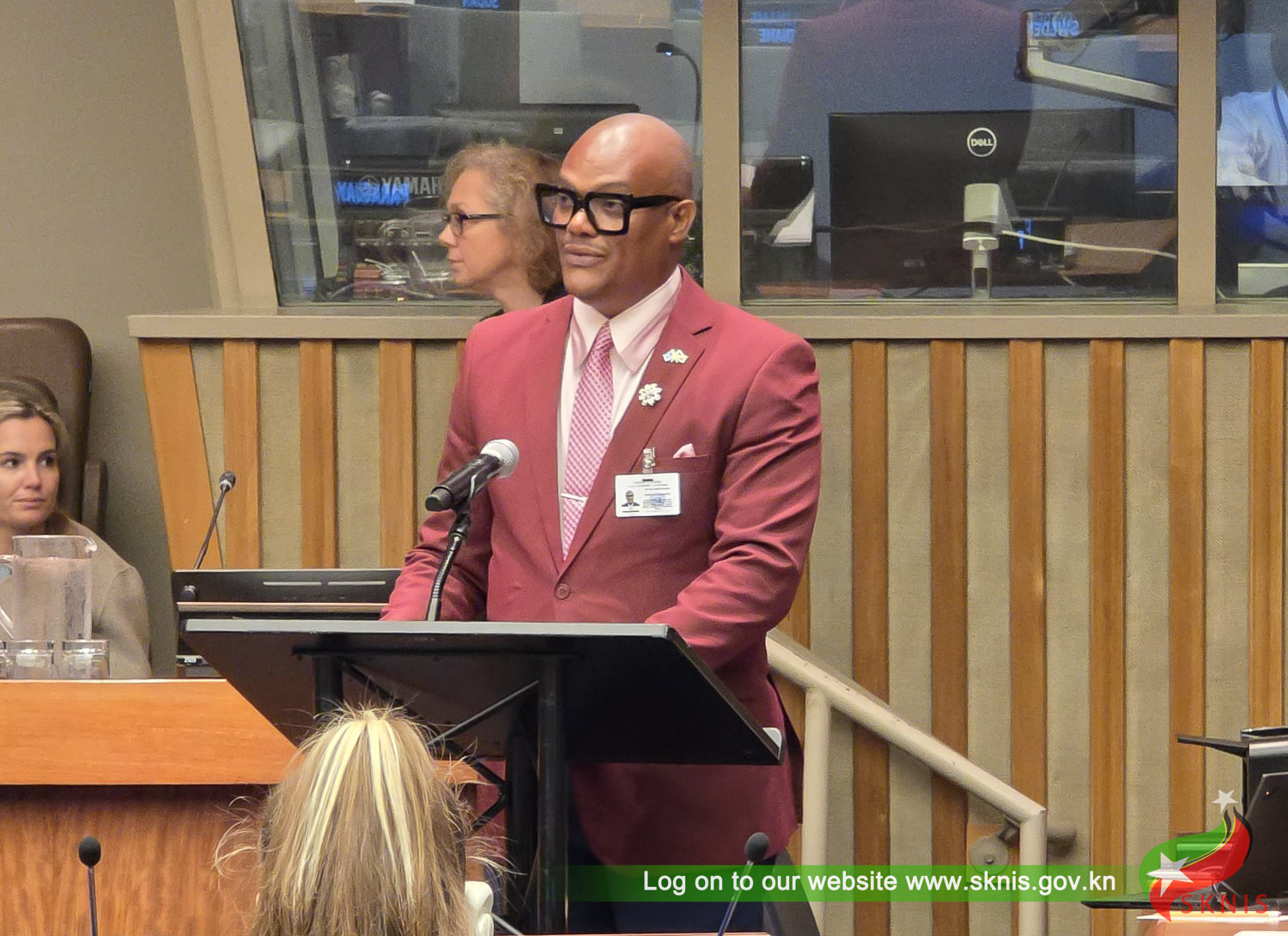
United Nations, New York, September 23, 2026 (SKNIS): Saint Kitts and Nevis has called for ocean literacy to move beyond awareness and become a catalyst for meaningful action, particularly for Small Island Developing States (SIDS) whose economies, livelihoods and survival are deeply connected to the ocean.
The call was made by Acting Prime Minister, the Honourable Dr. Geoffrey Hanley, during his intervention at the High-Level Moment on Ocean Literacy, held on the sidelines of the 81st Session of the United Nations General Assembly (UNGA81) in New York on Wednesday, September 23.
Dr. Hanley emphasised that for island nations, understanding the ocean is fundamental to building resilience and preparing communities to respond to the growing impacts of climate change.
“For small island developing states like Saint Kitts and Nevis, the ocean is not a commodity or a backdrop to our lives. It is our life, our future, and our survival,” Acting Prime Minister Hanley said.
He noted that ocean literacy can equip young people, fisherfolk and coastal communities with a better understanding of how the ocean regulates the climate, supports food systems and sustains livelihoods. Importantly, he said, access to scientific knowledge can help communities better understand and respond to rising seas, warming waters and changing currents.
Dr. Hanley stressed, however, that knowledge must be supported by the resources and international cooperation necessary to enable vulnerable countries to act.
“Ocean literacy must be accompanied by ocean justice: access to climate finance and ocean science, recognition of the unequal burden borne by vulnerable nations, and meaningful commitments from the industrialised world to address growing challenges like marine pollution,” he stated.
The acting prime minister also highlighted Saint Kitts and Nevis’ efforts to reduce single-use plastics and involve young people in coastal protection, underscoring the importance of translating awareness into practical action.
He urged the international community to ensure that island nations have access to the data, training and partnerships necessary to strengthen ocean resilience, while giving greater consideration to the experiences and leadership of countries whose survival is intrinsically linked to the health of the ocean.
Dr. Hanley concluded with a call for collective action to ensure that future generations inherit not only greater knowledge of the ocean, but a healthy ocean capable of sustaining their lives and livelihoods.
-30-