

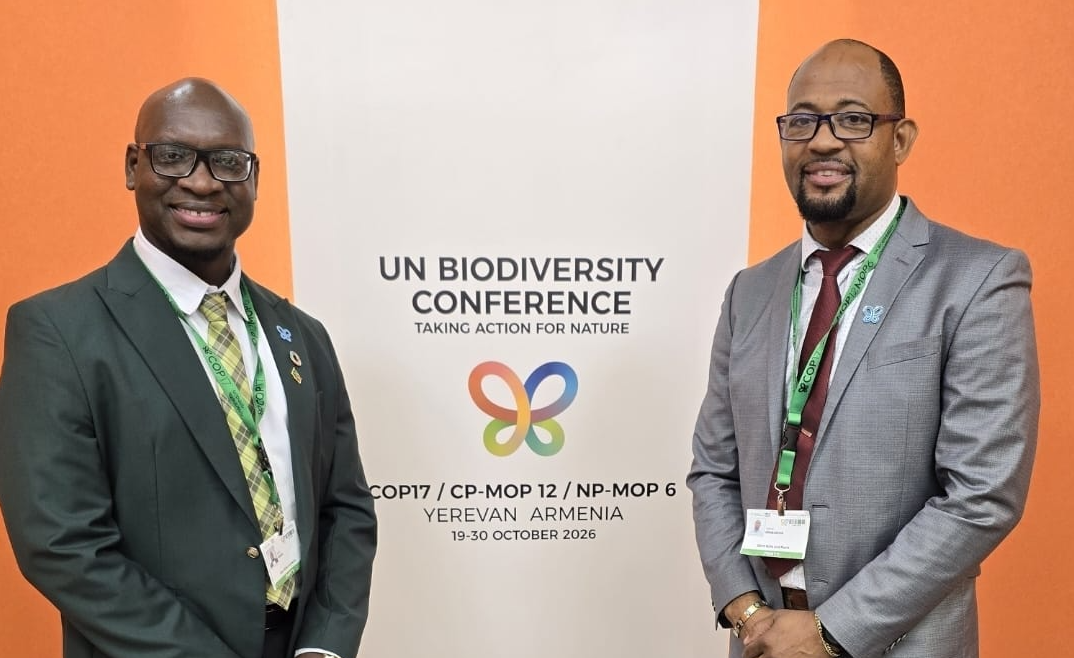
Basseterre, St. Kitts, 29 October 2026 – Saint Kitts and Nevis is advancing the priorities of Small Island Developing States (SIDS) at the United Nations Biodiversity Conference (COP17), advocating for accessible and predictable financing, stronger biodiversity monitoring systems, and enhanced regional cooperation to translate global commitments into meaningful national action.
Representing the Federation are Mr. Eavin Parry, Head of Delegation and National Focal Point for the Convention on Biological Diversity (CBD), and Mr. Deora Pemberton, Director of the Department of Physical Planning and Environment in the Nevis Island Administration. Held in Yerevan, Armenia, from 19 to 30 October 2026, COP17 brings together governments and international partners to advance global biodiversity conservation efforts.
This year’s conference marks an important milestone as countries undertake the first global review of the Kunming-Montreal Global Biodiversity Framework, adopted in 2022. The Framework establishes 23 targets aimed at halting and reversing biodiversity loss by 2030. The review provides an opportunity to assess progress, identify implementation gaps, and determine the support needed to accelerate global conservation efforts.
For Small Island Developing States such as Saint Kitts and Nevis, predictable financing, technical capacity and international cooperation are essential to managing protected areas, restoring vulnerable ecosystems and strengthening biodiversity monitoring. The Federation is also emphasising the importance of fair and equitable benefit-sharing from genetic resources, particularly digital sequence information, to ensure that countries and communities safeguarding biodiversity benefit from its value.
During the High-Level Segment on 28 October, Mr. Parry underscored the connection between biodiversity conservation, national development and community well-being. He highlighted the role of forests in safeguarding water security, coral reefs in protecting coastlines, and healthy ecosystems in supporting the Federation’s Sustainable Island State Agenda and its 2040 vision. He stated, “ environmental protection is fundamental to sustaining livelihoods and building long-term national resilience”.
The Federation’s national statement draws on findings and progress outlined in its Seventh National Report to the Convention on Biological Diversity. The report highlights advancements in environmental governance, efforts to strengthen the national protected area network, including conservation initiatives associated with Nevis Peak and the Camps River watershed, and ongoing ridge-to-reef restoration activities.
These initiatives are supported by the National Conservation and Environmental Management Act (NCEMA), which provides a legislative foundation for strengthening environmental protection and biodiversity management. Complementary measures addressing invasive species and plastic pollution further demonstrate the Federation’s commitment to tackling pressures on its natural ecosystems.
Despite this progress, Saint Kitts and Nevis recognises persistent barriers to effective implementation, including fragmented biodiversity data, limited technical and institutional capacity, and reliance on
short-term external funding. The Federation is therefore advocating for sustainable biodiversity financing, simplified access to funding mechanisms, effective technology transfer, and greater investment in regional cooperation, particularly through the CARICOM Secretariat.
Further contributing to the Federation’s engagement, Mr. Pemberton shared national perspectives at the UNEP–UNDP side event, “Responding to the Global Review,” held on 20 October. He highlighted the country’s biodiversity reporting processes and conservation progress, while identifying opportunities to mobilise Caribbean expertise, strengthen biodiversity monitoring, coordinate responses to shared environmental threats, and secure sustained financing for regional conservation efforts.
As COP17 concludes, Saint Kitts and Nevis is reinforcing its call for global biodiversity commitments to be matched by accessible financing, stronger national capacities, reliable data and meaningful international cooperation. For island nations on the frontlines of environmental change, these are essential requirements for protecting natural resources, securing livelihoods and building resilient communities for generations to come.