

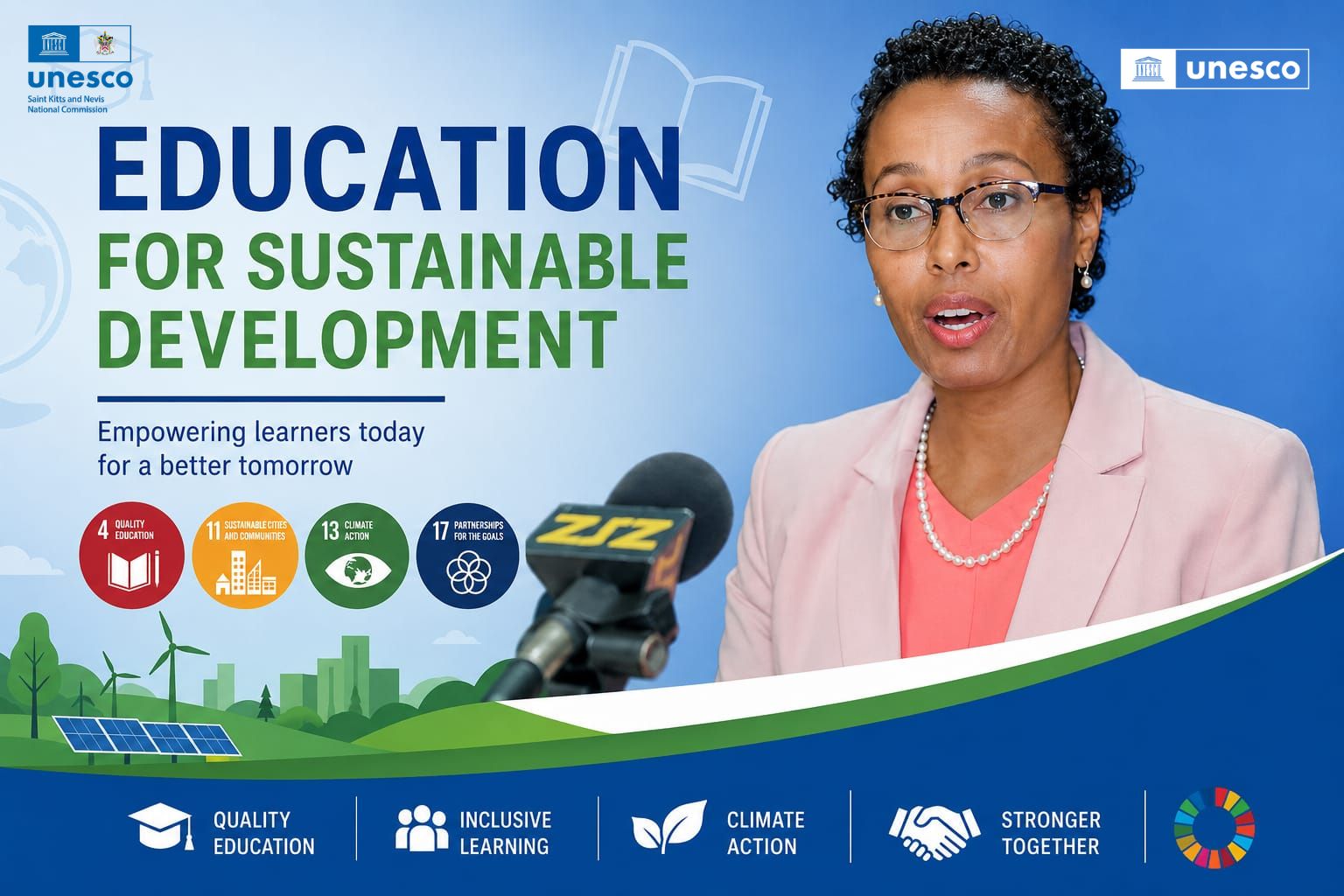
St. Kitts and Nevis National Commission for UNESCO (BASSETERRE, St. Kitts) – With technical support from UNESCO, the UN’s specialized education agency, St. Kitts and Nevis is set to become one of the few Small Island Developing States (SIDS) to integrate Education for Sustainable Development (ESD) into its national curriculum beginning September 2026.
According to Dr. Tricia Esdaille, Senior Assistant Secretary in the Ministry of Education and lead for the national ESD initiative, the Ministry’s Curriculum Development Unit has strengthened ESD content across the curriculum. A pilot of the enhanced curriculum will launch in the 2026–2027 academic year, with Grade 3 and Grade 5 students among the first beneficiaries.
Plans are underway to scale ESD across all secondary schools before 2030. The approach will prioritize experiential learning focused on food security, green energy transition, sustainable industries, social protection, and sustainable communities—ensuring ESD moves beyond theory into practice.
ESD will be embedded from Grades 3–6 and within the secondary Social Sciences programme for Forms 1 and 2, including History, Social Studies, and Geography. Following three years of UNESCO-guided work to establish a national ESD policy framework and learning outcomes, courses will be aligned to the environmental, social, and economic dimensions of sustainable development. Teaching will emphasize learner-centered, action-oriented pedagogies such as inquiry-based and project-based learning.
Deputy Prime Minister and Minister of Education, Hon. Dr. Geoffrey Hanley, welcomed the milestone: “The successful conclusion of the ESD project is one of three UNESCO flagship projects being implemented in St. Kitts and Nevis, alongside the scaling up of teacher qualifications through remote training with the Open University of Tanzania, and the strengthening of biodiversity credentials at the St. Mary’s Biosphere Reserve in Cayon.”
The Ministry benefited from a UNESCO ESD Initiative funded by the Government of Japan. This support enabled the recruitment of two leading UNESCO ESD experts who advanced a “whole institution approach” through the development of a national ESD policy, strategy, curriculum integration framework, and teacher capacity-building programme.
Dr. Esdaille stated: “By 2030, St. Kitts and Nevis will have a fully transformed education system grounded in Education for Sustainable Development, empowering all learners with the knowledge, skills, values, and agency to drive sustainable development, strengthen national resilience, and build a just, inclusive, and environmentally sustainable society.”
She added: “This vision reflects the strengthening of our national ESD agenda since 2022–2023 and the significant progress achieved by 2026 in aligning policy, practice, and stakeholder engagement. It recognizes that education must respond directly to the interlinked challenges of climate change, environmental degradation, and socio-economic vulnerability faced by Small Island Developing States.”
Key long-term outcomes of the national ESD framework to 2030 include:
- Full integration of ESD into the ongoing curriculum enhancement process.
- Integration of ESD into the Education Management Information System (EMIS) and other
data management systems.
- Development of a “green school” accreditation system for schools meeting criteria outlined in the National Safe School Policy.
- Integration of ESD into the Continuing Professional Development Framework for the Teaching Profession, expanding capacity-building for pre-service and in-service teachers.
- Enhanced integration of sustainable development principles within the TVET sector to support economic resilience and green skills development.
- Updated Education Sector Plan incorporating ESD across curriculum, learning environments, teacher accreditation, and school-parent-community relationships, aligned with SDG 4, Target 4.7.
- Revision of the Education Act to reflect the new Education Sector Plan and ESD commitments.
Throughout implementation, the Federation maintained continuous dialogue with UNESCO ESD experts at Headquarters and regular briefings coordinated by Ambassador H.E. David P. Doyle in Paris with H.E. Takehiro Kano, Ambassador of Japan to UNESCO.
H.E. Ambassador Doyle noted: “St. Kitts and Nevis, along with Cabo Verde, were the only SIDS selected by UNESCO to pilot the ESD project. Guided by UNESCO’s ESD for 2030 framework, this initiative is advancing a whole-of-system transformation anchored in five priority areas: policy advancement, transformation of learning environments, educator capacity development, youth empowerment, and local action. These ensure ESD is embedded across formal, non-formal, and informal learning.”
H.E. Nerys Dockery, Secretary-General of the St. Kitts and Nevis National Commission for UNESCO, also welcomed the progress, stating: “This achievement demonstrates what is possible when national vision aligns with international expertise and partnership. ESD will equip our young people to lead St. Kitts and Nevis toward a sustainable future.”
END