

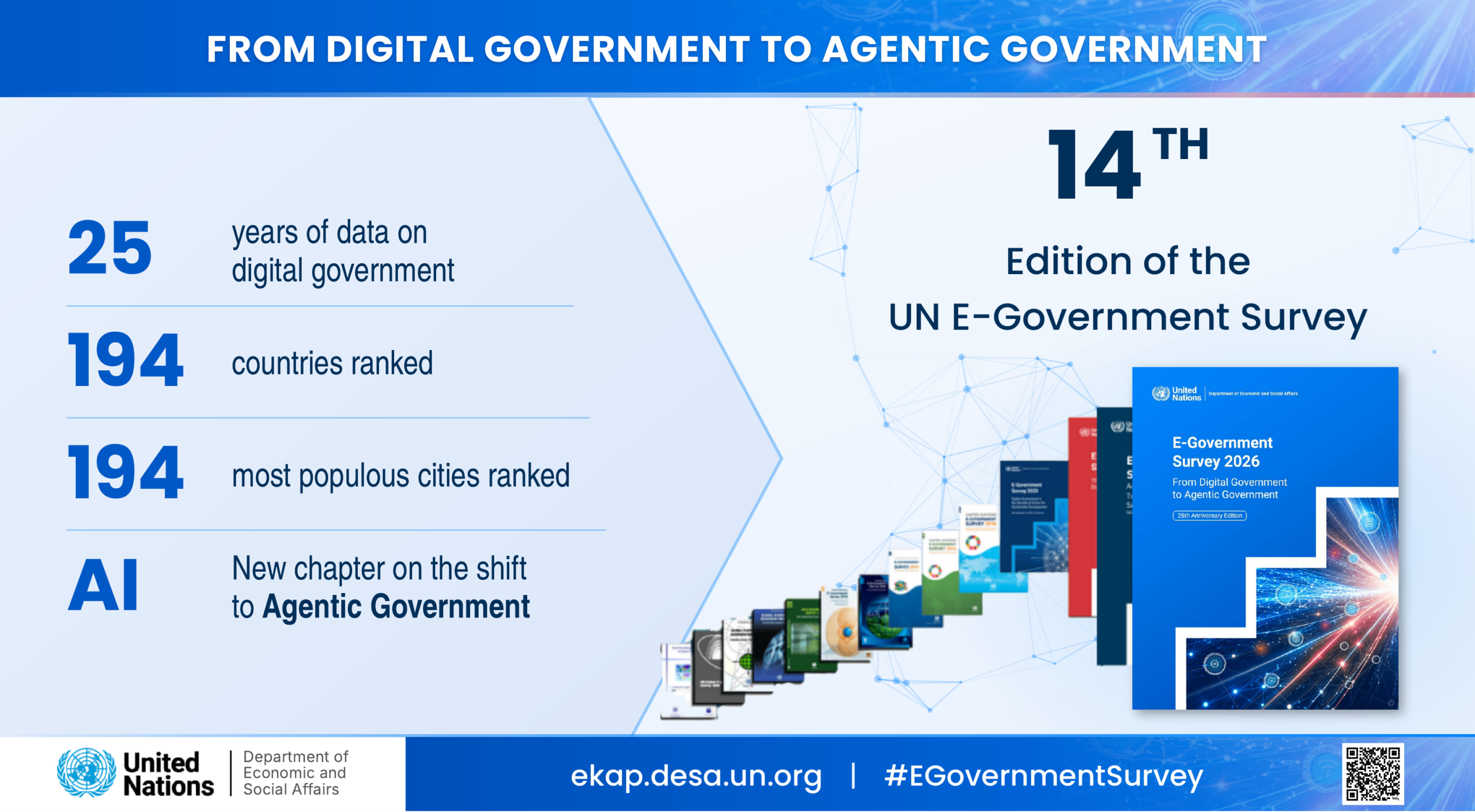
BASSETERRE, St Kitts, November 20, 2026 (SKNIS): Saint Kitts and Nevis has secured third place in the Caribbean and 81st out of 194 countries in the United Nations E-Government Survey 2026, marking the Federation’s entry into the “Very High” category of the E-Government Development Index (EGDI) for the first time.
The biennial Survey, published by the United Nations Department of Economic and Social Affairs (UN DESA), assesses how governments use digital technology to strengthen public administration and deliver public services. Only Trinidad and Tobago (70th) and the Dominican Republic (79th) placed ahead of Saint Kitts and Nevis in the Caribbean.
Saint Kitts and Nevis recorded an EGDI score of 0.7582 in 2026, up from 0.6305 in 2024 – an increase of more than 20 per cent in two years. This is more than double the 8.2 per cent average improvement recorded across all Small Island Developing States (SIDS) over the same period.
The Federation is one of only three Caribbean countries – alongside Trinidad and Tobago and the Dominican Republic — and one of just eleven countries worldwide to move from the “High” to the “Very High” EGDI group in 2026. The UN report identifies the Caribbean as the principal source of new progress in the Americas this cycle and singles out the advances of these three countries as particularly notable because they rest on relatively balanced performance across online services, human capital, and telecommunications infrastructure.
Saint Kitts and Nevis is also the highest-ranked member state of the Organisation of Eastern Caribbean States (OECS) in the 2026 Survey.
The EGDI is made up of three equally weighted components: the Online Services Index, the Telecommunications Infrastructure Index, and the Human Capital Index.
Saint Kitts and Nevis achieved a Human Capital Index score of 0.8411 – the highest of any Caribbean country in the Survey – reflecting the strength of the Federation’s education system and the digital readiness of its people. The Federation’s Telecommunications Infrastructure Index score of 0.7985 is also among the very highest in the Caribbean, reflecting the Federation’s strong connectivity and digital infrastructure.
The Survey also assesses city-level digital government through its Local Online Service Index (LOSI), which assessed 194 cities worldwide. Basseterre ranked joint 59th globally (alongside Budapest, Dublin, and Bucharest) with a LOSI score of 0.7822 – the highest-ranked Caribbean city in the assessment, ahead of Santo Domingo (80th), Castries (83rd) and Havana (108th).
“This recognition by the United Nations is a proud moment for St Kitts and Nevis. To rise into the ‘Very High’ group for the first time, and to stand third in the Caribbean and first among our OECS partners, tells us that the investments we are making in our people, our infrastructure and our public services are bearing fruit,” said Prime Minister, the Honourable Dr Terrance Drew. “Our people are the foundation of this success – the UN has ranked our human capital the best in the Caribbean. Our task now is to match that talent with public services that are simpler, faster and available online, so that every citizen and business in St Kitts and Nevis can deal with the government wherever they are, whenever they need to.”

The Government of Saint Kitts and Nevis remains committed to the digital transformation of the public sector as a pillar of the Sustainable Island State Agenda. The 2026 results provide a strong platform for the next phase of that work, with continued expansion of online government services identified as the key opportunity for further gains in future editions of the Survey.
The United Nations E-Government Survey is published every two years by UN DESA and has been produced since 2001. The 2026 edition assesses digital government development across all 193 United Nations Member States. Countries are ranked on the E-Government Development Index, an equally weighted average of the Online Services Index, the Telecommunications Infrastructure Index, and the Human Capital Index, and are grouped into Very High, High, Middle and Low EGDI categories.
The survey is available online at https://ekap.desa.un.org/
-30-