

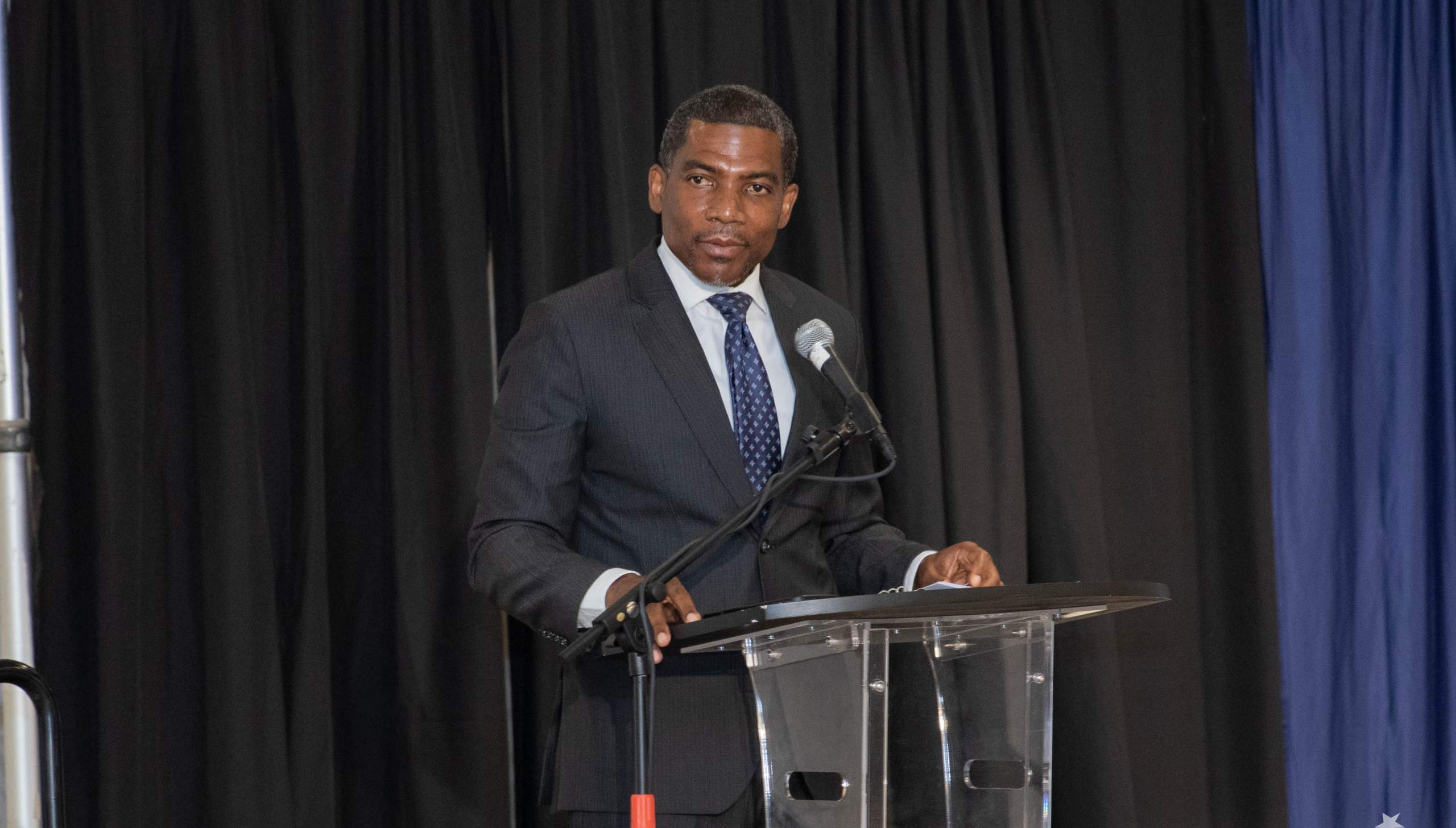
Basseterre, St Kitts, May 21, 2026 (PMO): Prime Minister of St. Kitts and Nevis and Chairman of CARICOM, the Hon. Dr. Terrance Drew, stressed that meaningful and lasting progress in addressing crime and violence across the Caribbean cannot be achieved without decisive leadership and political commitment.
Delivering remarks at the launch of the CARICOM–UNDP Diagnostic Document and CARICOM–UN Action Framework on May 21st, Prime Minister Drew identified political will as the critical ingredient necessary to move crime prevention strategies from theory into action.
“I’ve always held that nothing can really be done unless there’s political will,” Prime Minister Drew said. “The political will is what allows us to be able to implement policies and to put whatever is necessary behind it to get it done.”
The Prime Minister explained that one of the most difficult challenges in advancing a preventative approach to crime and violence is not necessarily proving the science behind it, but convincing leadership structures and the wider society to embrace a shift away from viewing crime solely through the lens of policing and punishment.
Drawing on his experience as Minister of National Security, Prime Minister Drew described the difficult but necessary conversations that took place in St. Kitts and Nevis to build support around a broader societal approach to reducing crime.
“I told them that that crime and violence is not a political football, it is a societal matter. It is not merely a law enforcement matter,” he stated. “And if we are going to deal with a societal issue, then all of us need to be on board.”
Prime Minister Drew said achieving this required unprecedented collaboration and the willingness to engage all sectors of society, including members of the government and opposition, social agencies, health professionals, churches, educational institutions, businesses and international partners.
That approach aligns closely with the Government’s broader Citizen Security framework, which has focused on strengthening interagency coordination, increasing social intervention programmes, promoting evidence-based strategies and fostering community partnerships. Government initiatives over the past several years have increasingly centered on public health, prevention and community resilience as essential tools for national development and security.
The Prime Minister acknowledged that political leadership often faces pressure to pursue more immediate responses during periods of heightened violence. However, he maintained that long-term transformation requires addressing root causes.
“It is hard because I know another politician who tried to sell the concept, and he was ridiculed,” he said. “So I said, well, this makes sense scientifically. It is not guesswork.”
Prime Minister Drew expressed confidence that the growing partnership between CARICOM and the United Nations signals a wider acceptance of evidence-based strategies and represents an important turning point for the Caribbean.
“I really want this to be successful,” he said. “I really want to see it implemented.”
As Chairman of CARICOM, Prime Minister Drew reaffirmed his support for regional collaboration and preventative approaches that seek not only to reduce crime statistics, but to strengthen communities and improve societal wellbeing across the region.